Antique Japanese Katana Sword with Floral Iron Sukashi Tsuba, Edo Period Mumei Blade
- Signature (Mei): Mumei (無銘) - unsigned
- Type: Katana
- Period: Edo Period (Shintō)
- Mounting: Black urushi koshirae with iron sukashi tsuba and black leather-wrapped tsuka
- Blade Length (Nagasa): approx. 69 cm
- Curvature (Sori): 1.4 cm
- Mekugi-ana: 1
- Shape: Shinogi-zukuri with iori-mune and chū-kissaki
- Jihada: Tight, bright ko-itame
- Hamon: Suguha-chō with gentle notare, nioiguchi with ko-nie
- Boshi: Ko-maru
This Katana is a mumei (unsigned) blade of the Edo period, presented on its own merits—an honest antique Japanese sword, registered in Japan and offered for what the steel itself shows rather than for a name on the tang.
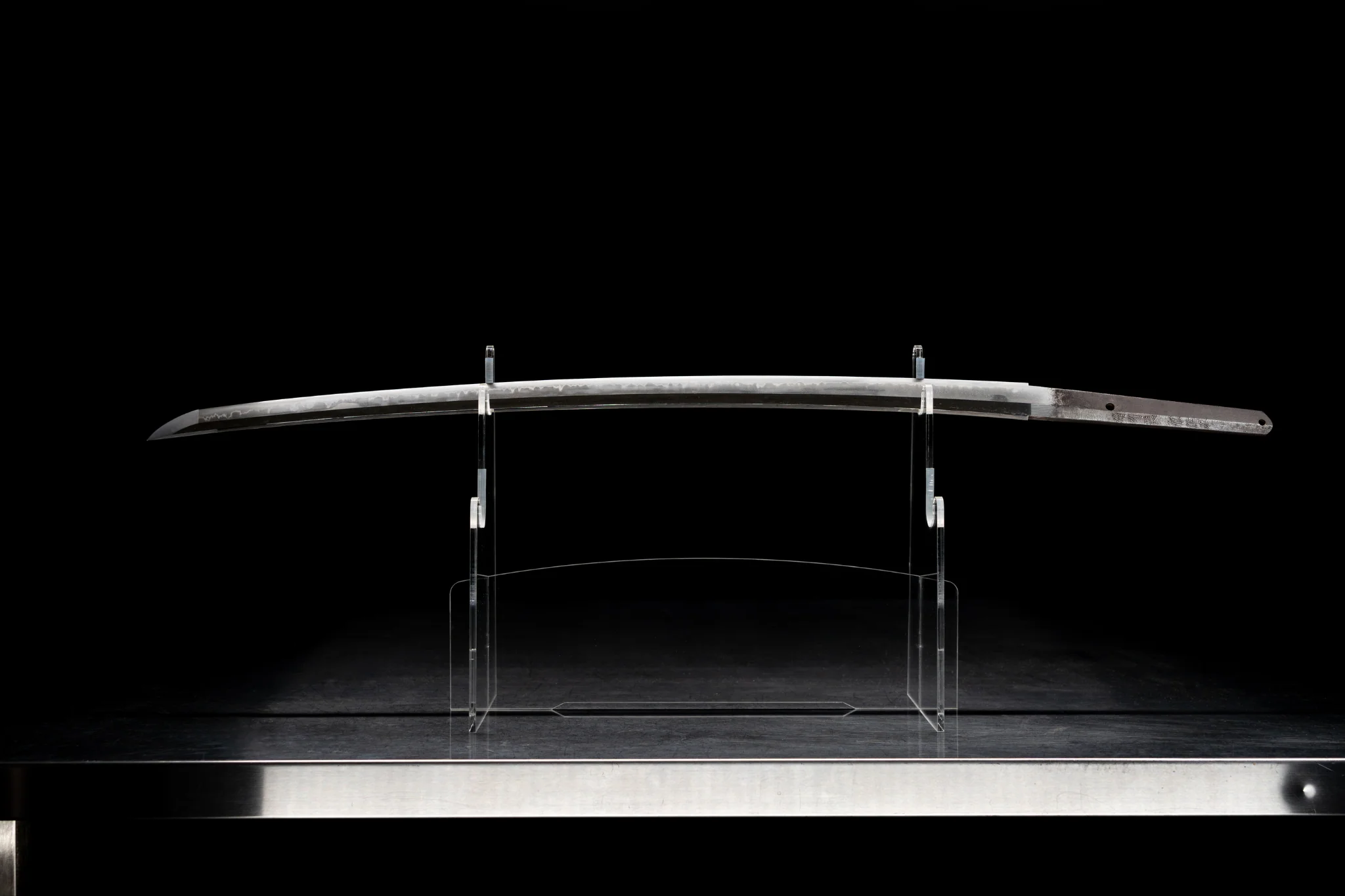
The sugata is a clean shinogi-zukuri with iori-mune, a balanced chū-kissaki, and a moderate 1.4 cm sori—the composed, practical profile of an Edo-period katana made for a samurai to wear and use. In hand the blade is healthy and well-polished, with good substance from machi to point.
The jihada is a tight, well-packed ko-itame, bright and cleanly forged, the kind of disciplined grain that reads as quiet quality rather than showmanship. Against it, the hamon runs as a calm suguha-chō—a straight temper line with a gentle notare undulation—set in a soft nioiguchi with fine ko-nie. The boshi turns back in a tidy ko-maru. This is a restrained, classical aesthetic: the appeal is in the evenness of the work and the brightness of the steel, not in dramatic activity.
A mumei Edo blade like this is exactly what many collectors are looking for as a first authentic nihonto—a genuine, traditionally-forged Japanese sword in honest condition, without the price premium a signature commands. A buyer who later wants formal papers can submit it to NBTHK shinsa.
Koshirae Details
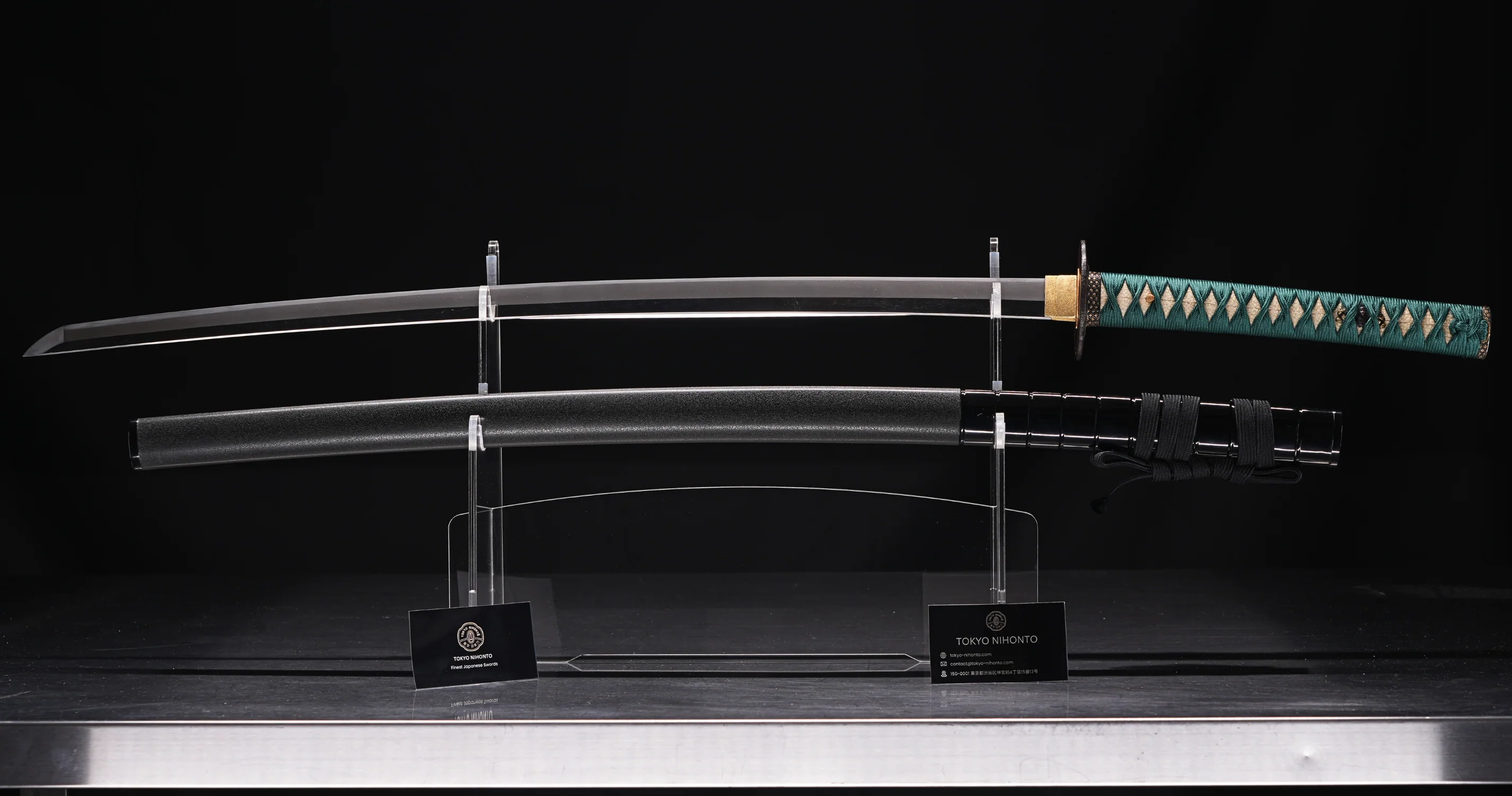
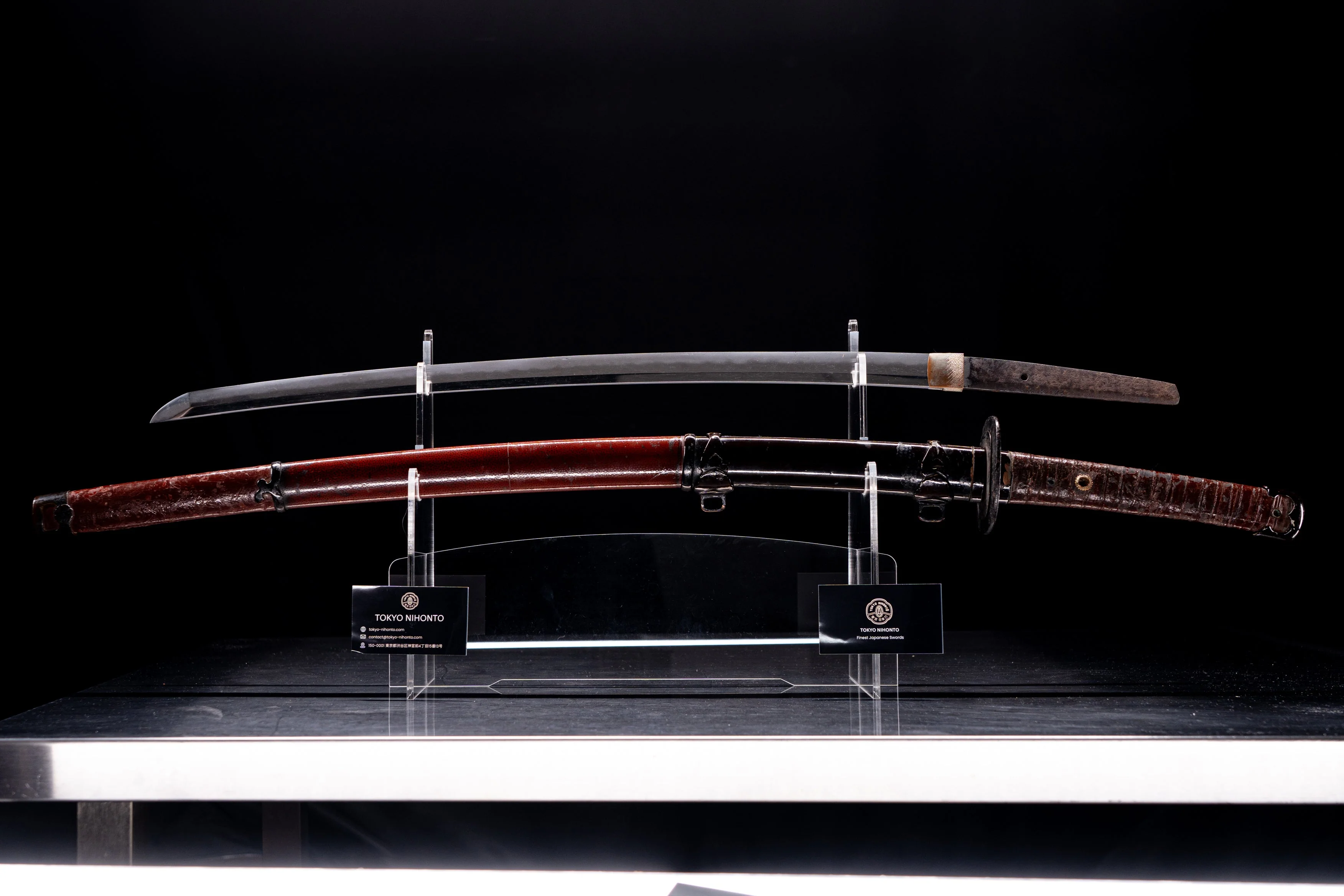
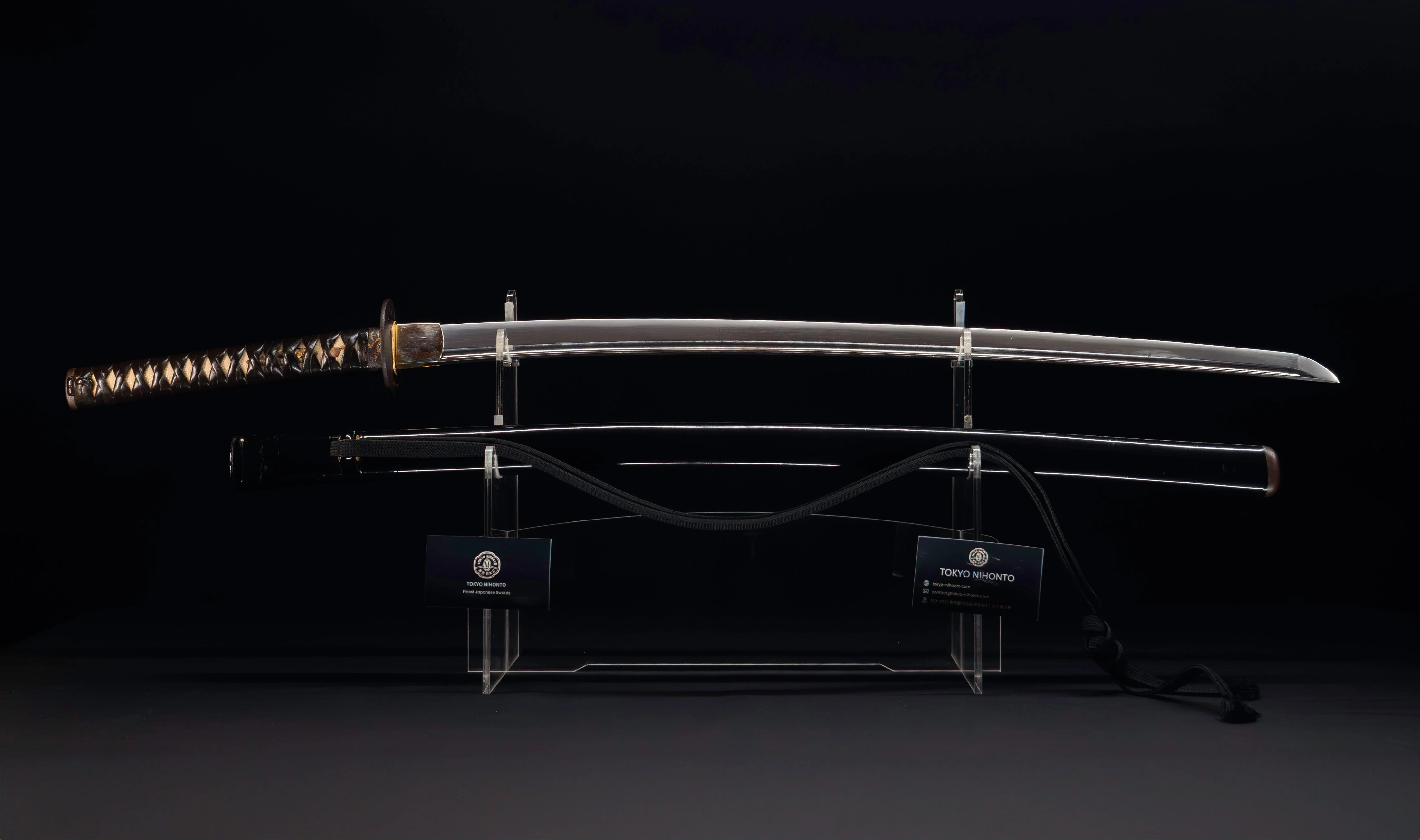
The sword comes in a complete and coordinated black koshirae. The saya is finished in glossy black urushi lacquer—plain and dignified—and dressed with a black sageo.
The tsuba is a round tetsu (iron) plate with a dark patina, cut in ji-sukashi (openwork): a stylized floral spray with radiating petals above and a leafy foliage sprig below, with two hitsu-ana for kozuka and kōgai. The fuchi is worked in dark soft metal with a delicate floral design—plum and foliage—picked out in gilt, a refined touch against the sober mounting.
The tsuka is wrapped in black leather (kawa) over white same (rayskin) in the traditional hineri-maki diamond pattern, with finely detailed gilt-highlighted dragon menuki set beneath the wrap. The leather shows honest age and a little minor wear—the kind of character expected of a sword that has been carried and kept rather than locked away. The habaki is a gilt collar. Altogether the fittings make a quiet, tasteful samurai mounting.
About Mumei Edo Katana
A mumei (unsigned) blade is not a lesser blade—it is simply one without a signature on the nakago (tang). Plenty of Edo-period swords left the forge unsigned, and many others lost their signature when shortened over the centuries. What matters is the workmanship: the steel, the temper line, the shape, and the health of the blade. Those are things you can see and hold, and they are the real basis on which a nihonto should be judged.
For a collector, a mumei Edo katana offers a genuine, traditionally-made Japanese sword—forged from tamahagane, hardened with the clay-and-water method that produces the hamon—at a more accessible level than a signed, papered piece by a famous name. This example is an honest, attractive representative of that category: a real Edo blade in full mounts, registered in Japan and ready to study, display, or build a collection around.
- Signature (Mei): Mumei (無銘) - unsigned
- Type: Katana
- Period: Edo Period (Shintō)
- Mounting: Black urushi koshirae with iron sukashi tsuba and black leather-wrapped tsuka
- Blade Length (Nagasa): approx. 69 cm
- Curvature (Sori): 1.4 cm
- Mekugi-ana: 1
- Shape: Shinogi-zukuri with iori-mune and chū-kissaki
- Jihada: Tight, bright ko-itame
- Hamon: Suguha-chō with gentle notare, nioiguchi with ko-nie
- Boshi: Ko-maru
This Katana is a mumei (unsigned) blade of the Edo period, presented on its own merits—an honest antique Japanese sword, registered in Japan and offered for what the steel itself shows rather than for a name on the tang.
The sugata is a clean shinogi-zukuri with iori-mune, a balanced chū-kissaki, and a moderate 1.4 cm sori—the composed, practical profile of an Edo-period katana made for a samurai to wear and use. In hand the blade is healthy and well-polished, with good substance from machi to point.
The jihada is a tight, well-packed ko-itame, bright and cleanly forged, the kind of disciplined grain that reads as quiet quality rather than showmanship. Against it, the hamon runs as a calm suguha-chō—a straight temper line with a gentle notare undulation—set in a soft nioiguchi with fine ko-nie. The boshi turns back in a tidy ko-maru. This is a restrained, classical aesthetic: the appeal is in the evenness of the work and the brightness of the steel, not in dramatic activity.
A mumei Edo blade like this is exactly what many collectors are looking for as a first authentic nihonto—a genuine, traditionally-forged Japanese sword in honest condition, without the price premium a signature commands. A buyer who later wants formal papers can submit it to NBTHK shinsa.
Koshirae Details
The sword comes in a complete and coordinated black koshirae. The saya is finished in glossy black urushi lacquer—plain and dignified—and dressed with a black sageo.
The tsuba is a round tetsu (iron) plate with a dark patina, cut in ji-sukashi (openwork): a stylized floral spray with radiating petals above and a leafy foliage sprig below, with two hitsu-ana for kozuka and kōgai. The fuchi is worked in dark soft metal with a delicate floral design—plum and foliage—picked out in gilt, a refined touch against the sober mounting.
The tsuka is wrapped in black leather (kawa) over white same (rayskin) in the traditional hineri-maki diamond pattern, with finely detailed gilt-highlighted dragon menuki set beneath the wrap. The leather shows honest age and a little minor wear—the kind of character expected of a sword that has been carried and kept rather than locked away. The habaki is a gilt collar. Altogether the fittings make a quiet, tasteful samurai mounting.
About Mumei Edo Katana
A mumei (unsigned) blade is not a lesser blade—it is simply one without a signature on the nakago (tang). Plenty of Edo-period swords left the forge unsigned, and many others lost their signature when shortened over the centuries. What matters is the workmanship: the steel, the temper line, the shape, and the health of the blade. Those are things you can see and hold, and they are the real basis on which a nihonto should be judged.
For a collector, a mumei Edo katana offers a genuine, traditionally-made Japanese sword—forged from tamahagane, hardened with the clay-and-water method that produces the hamon—at a more accessible level than a signed, papered piece by a famous name. This example is an honest, attractive representative of that category: a real Edo blade in full mounts, registered in Japan and ready to study, display, or build a collection around.
Original: $2,800.00
-65%$2,800.00
$980.00Description
- Signature (Mei): Mumei (無銘) - unsigned
- Type: Katana
- Period: Edo Period (Shintō)
- Mounting: Black urushi koshirae with iron sukashi tsuba and black leather-wrapped tsuka
- Blade Length (Nagasa): approx. 69 cm
- Curvature (Sori): 1.4 cm
- Mekugi-ana: 1
- Shape: Shinogi-zukuri with iori-mune and chū-kissaki
- Jihada: Tight, bright ko-itame
- Hamon: Suguha-chō with gentle notare, nioiguchi with ko-nie
- Boshi: Ko-maru
This Katana is a mumei (unsigned) blade of the Edo period, presented on its own merits—an honest antique Japanese sword, registered in Japan and offered for what the steel itself shows rather than for a name on the tang.
The sugata is a clean shinogi-zukuri with iori-mune, a balanced chū-kissaki, and a moderate 1.4 cm sori—the composed, practical profile of an Edo-period katana made for a samurai to wear and use. In hand the blade is healthy and well-polished, with good substance from machi to point.
The jihada is a tight, well-packed ko-itame, bright and cleanly forged, the kind of disciplined grain that reads as quiet quality rather than showmanship. Against it, the hamon runs as a calm suguha-chō—a straight temper line with a gentle notare undulation—set in a soft nioiguchi with fine ko-nie. The boshi turns back in a tidy ko-maru. This is a restrained, classical aesthetic: the appeal is in the evenness of the work and the brightness of the steel, not in dramatic activity.
A mumei Edo blade like this is exactly what many collectors are looking for as a first authentic nihonto—a genuine, traditionally-forged Japanese sword in honest condition, without the price premium a signature commands. A buyer who later wants formal papers can submit it to NBTHK shinsa.
Koshirae Details
The sword comes in a complete and coordinated black koshirae. The saya is finished in glossy black urushi lacquer—plain and dignified—and dressed with a black sageo.
The tsuba is a round tetsu (iron) plate with a dark patina, cut in ji-sukashi (openwork): a stylized floral spray with radiating petals above and a leafy foliage sprig below, with two hitsu-ana for kozuka and kōgai. The fuchi is worked in dark soft metal with a delicate floral design—plum and foliage—picked out in gilt, a refined touch against the sober mounting.
The tsuka is wrapped in black leather (kawa) over white same (rayskin) in the traditional hineri-maki diamond pattern, with finely detailed gilt-highlighted dragon menuki set beneath the wrap. The leather shows honest age and a little minor wear—the kind of character expected of a sword that has been carried and kept rather than locked away. The habaki is a gilt collar. Altogether the fittings make a quiet, tasteful samurai mounting.
About Mumei Edo Katana
A mumei (unsigned) blade is not a lesser blade—it is simply one without a signature on the nakago (tang). Plenty of Edo-period swords left the forge unsigned, and many others lost their signature when shortened over the centuries. What matters is the workmanship: the steel, the temper line, the shape, and the health of the blade. Those are things you can see and hold, and they are the real basis on which a nihonto should be judged.
For a collector, a mumei Edo katana offers a genuine, traditionally-made Japanese sword—forged from tamahagane, hardened with the clay-and-water method that produces the hamon—at a more accessible level than a signed, papered piece by a famous name. This example is an honest, attractive representative of that category: a real Edo blade in full mounts, registered in Japan and ready to study, display, or build a collection around.